Your CEO read an article about AI search. Now the directive is clear: rewrite the entire content library to be “AI-optimized.” The content team is overwhelmed. The budget is already stretched. And the approach is fundamentally flawed.
Mass content rewrites waste resources, risk losing existing rankings, and miss the actual opportunity. Strategic optimization of your highest-impact content delivers better results in a fraction of the time.
What Content Strategists Get Wrong About AI Optimization
The panic-driven response to AI search is a complete content overhaul. Teams assume every page needs to be rewritten with new formatting, new keywords, and new structures to satisfy AI models.
This assumption is wrong on multiple levels. AI models do not evaluate content the same way search algorithms do. Rewriting a page to “optimize” it for AI without understanding what AI models actually value often makes the content worse for both humans and machines.
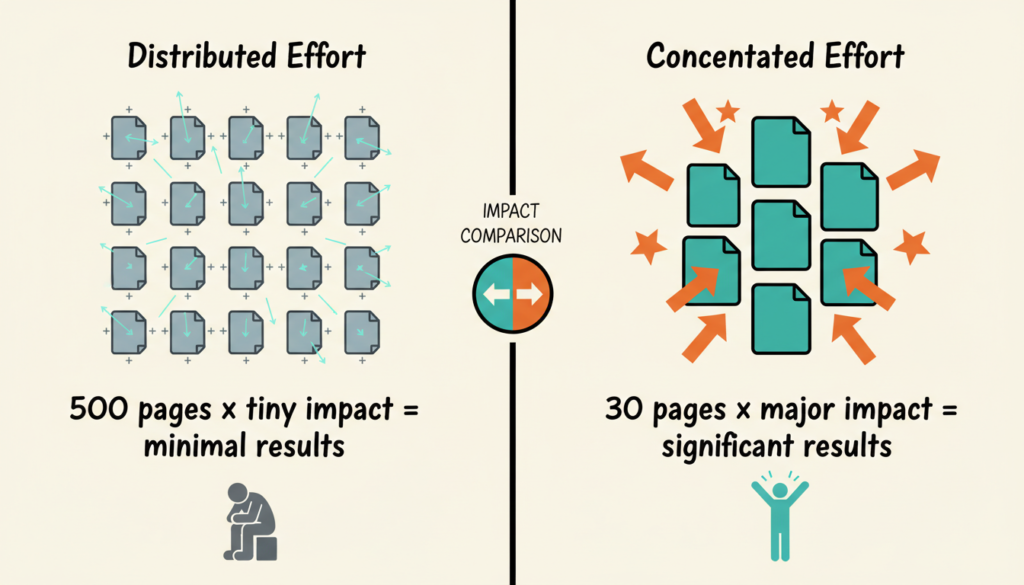
The other mistake is treating all content equally. A company with 500 blog posts does not need to rewrite 500 blog posts. It needs to identify the 30 to 50 pages that matter most for AI visibility and optimize those strategically.
Rewriting everything is a resource-destruction strategy disguised as progress.
What Strategic AI Content Optimization Requires
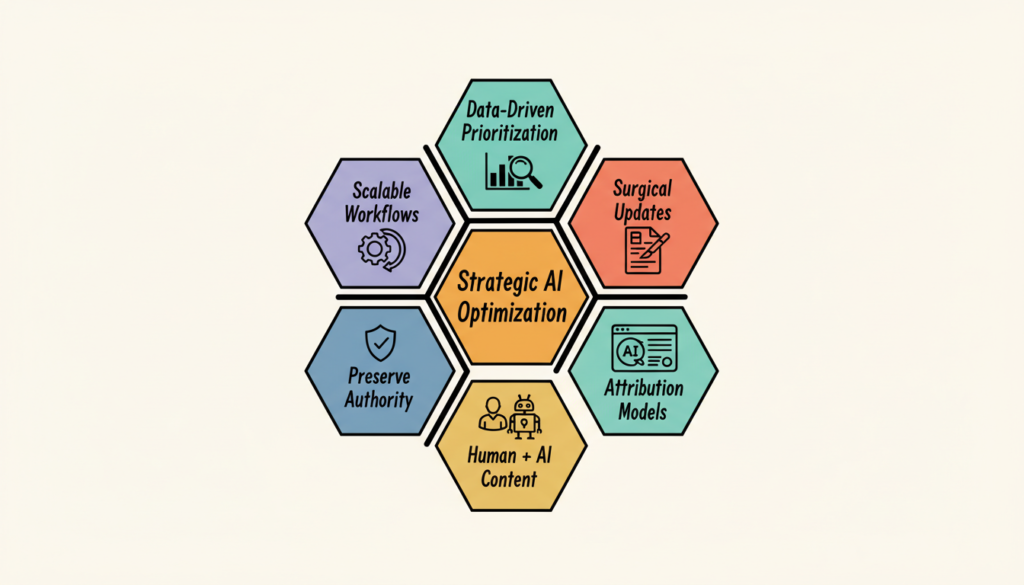
Data-Driven Prioritization
Not all pages matter equally for AI visibility. Use analytics to identify which pages drive the most business value, which keywords your audience searches in AI platforms, and which competitors currently own those citations. Optimize the pages with the highest potential return first.
Surgical Updates Over Complete Rewrites
Most high-performing pages need targeted improvements, not complete rewrites. Add structured data. Improve answer-format sections. Update statistics with current data. Strengthen source citations. These changes take a fraction of the time and preserve the ranking equity your page already holds.
Attribution Models That Measure AI Impact
You cannot optimize what you cannot measure. Build tracking systems that monitor AI citations, not just Google rankings. Without this data, every optimization decision is guesswork. A disciplined approach to ai search optimization starts with measurement infrastructure before any content changes begin.
Content That Serves Both Humans and AI Models
AI-optimized content should also be better content for human readers. Clearer structure, more specific claims, better data, and more direct answers improve the experience for everyone. If your optimization makes content worse for humans, your approach is wrong.
Preserving Existing Authority Signals
Pages with strong backlink profiles, high engagement metrics, and years of ranking history carry significant authority. Rewriting these pages from scratch risks destroying that accumulated value. Optimize in place. Keep URLs stable. Build on what already works.
Scalable Optimization Workflows
Create repeatable processes for content optimization. Build templates, checklists, and style guides that your team can apply consistently. A scalable workflow lets you optimize 10 pages per week without burning out your content team.
Practical Steps for Smart AI Content Optimization
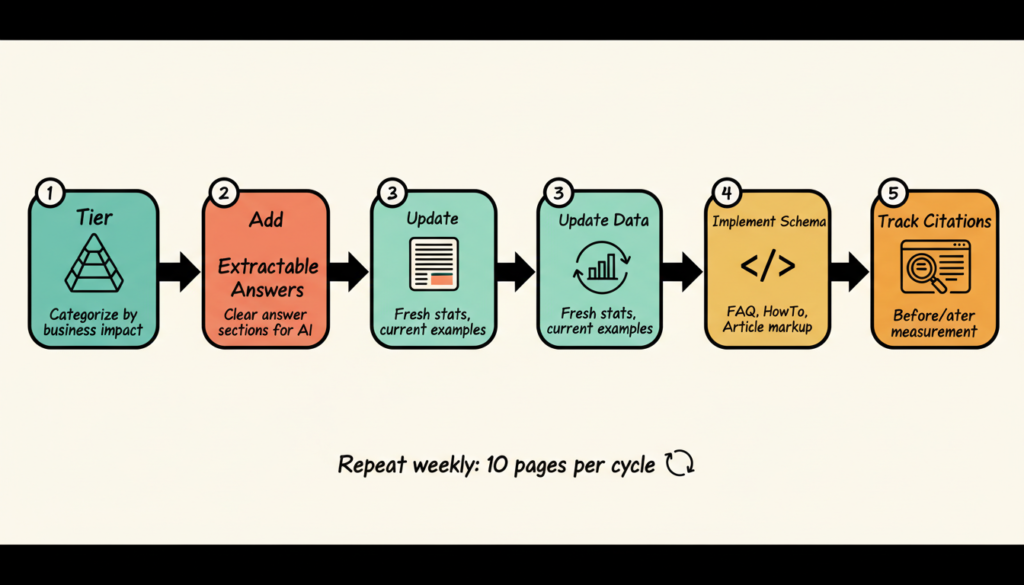
Tier your content library by business impact. Categorize every page into three tiers. Tier one: pages that directly influence revenue and should be optimized immediately. Tier two: pages with moderate value that can be optimized next quarter. Tier three: pages that can be deprioritized or archived. Focus 80 percent of your effort on tier one.
Add extractable answer sections to top pages. For each tier-one page, add a clearly formatted section that directly answers the primary question the page targets. Use a definition, a numbered process, or a comparison table. This makes your content easy for AI models to extract and cite.
Update data and examples without rewriting. Review your top pages for outdated statistics, old screenshots, and stale examples. Replace these with current information while keeping the core argument and structure intact. Fresh data signals relevance to AI retrieval systems.
Implement schema markup across tier-one pages. Add FAQ, HowTo, Article, and Product schema as appropriate. This structured data layer helps AI systems categorize and extract your content accurately. Effective ai search optimization treats schema markup as essential metadata, not a technical afterthought.
Track citation metrics before and after optimization. Run AI platform queries for your target keywords before optimizing each page. Record the results. After optimization, run the same queries weekly for four weeks. This before-and-after measurement proves what works and informs your approach for the next batch of pages.
Your Competitors Are Optimizing Smarter, Not Harder
The content teams that win in AI search are not the ones rewriting everything. They are the ones optimizing strategically with data-driven prioritization and measured iteration.
While your team exhausts itself rewriting hundreds of pages, focused competitors are optimizing their top 30 assets and seeing results. They move faster because they do less, but they do the right things.
Every resource you spend on low-impact rewrites is a resource not spent on the high-impact optimizations that actually change your AI visibility. The math is straightforward. Concentrated effort beats distributed effort.
Stop rewriting everything. Start optimizing what matters. The results will prove the strategy right.