Your organic traffic numbers are declining, and you cannot explain why. Rankings look stable. Content quality has not changed. But clicks keep dropping month over month.
The answer is generative engines. AI-powered search tools now answer user questions directly, and your carefully optimized pages get summarized instead of visited. Understanding this shift is the first step to surviving it.
What Most Content Teams Get Wrong About Traffic Decline
Content marketers blame algorithm updates when traffic drops. They audit backlinks, refresh meta descriptions, and republish old posts. None of this addresses the real problem.
Generative engines do not send users to your site. They extract your information and deliver it in a conversational answer. Your content still gets used. You just do not get the visit.
The mistake is treating this as a temporary disruption. It is a permanent structural change in how search works. Optimizing for clicks alone is optimizing for a shrinking pool.
Traffic is not disappearing. It is being redirected through AI intermediaries you do not control.
What Generative Engine Optimization Actually Requires
Content That Earns Citations, Not Just Rankings
Generative engines cite sources when they provide answers. Your goal is to become a cited source. This requires content that makes specific, verifiable claims backed by data. Vague thought leadership does not get cited.
Clear Entity and Brand Signals
AI models need to understand who you are before they recommend you. Build consistent brand information across every platform where your audience searches. Conflicting information across sources confuses models and costs you citations.
Analytics That Track AI Visibility
Traditional analytics tools do not measure generative engine performance. You need attribution models that track when and where AI engines reference your content. Without this data, you are flying blind. Teams serious about ai search optimization build these measurement systems before scaling content production.
Multi-Channel Authority Building
AI models evaluate authority across channels, not just your website. Your presence on social platforms, industry publications, podcasts, and third-party review sites all influence whether a generative engine trusts your brand enough to cite it.
Technical Infrastructure for AI Crawlers
AI crawlers behave differently than traditional search bots. They need clean HTML structure, explicit schema markup, and fast-loading pages. Blocking AI crawlers or serving them degraded content removes you from the citation pool entirely.
Speed of Content Deployment
Generative models update their knowledge bases on rolling schedules. Content published last quarter may already be stale in the model’s view. Maintain a consistent publishing cadence so models see your brand as an active, current authority.
Practical Steps to Protect and Grow Your Traffic
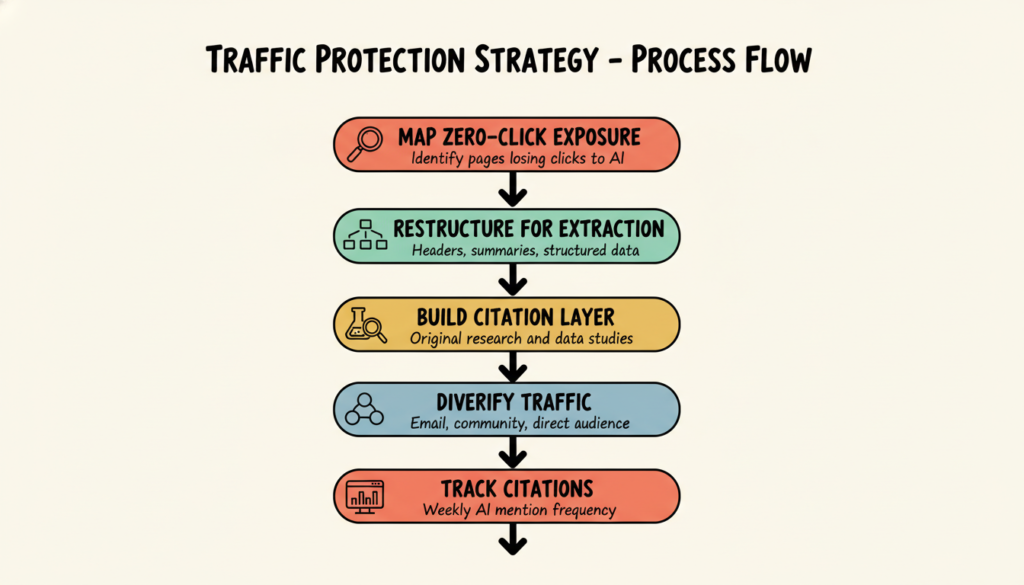
Map your zero-click exposure. Identify which of your pages currently lose clicks to AI-generated answers. Query your top keywords in ChatGPT, Perplexity, and Google AI Overviews. Document which competitors get cited instead of you.
Restructure content for extractability. AI models pull from content that uses clear headers, direct answer formats, and structured data. Add summary boxes, definition sections, and comparison tables to your highest-value pages.
Build a citation-worthy content layer. Publish original research, proprietary benchmarks, and expert interviews. Generative engines prefer primary sources over aggregated opinions. One data-driven study earns more citations than ten blog posts.
Diversify your traffic sources now. Do not wait until organic search traffic drops further. Invest in email lists, community platforms, and direct audience relationships that bypass search entirely. Brands applying ai search optimization principles build these parallel channels as a hedge against continued AI disruption.
Track citation metrics alongside traffic metrics. Add a weekly review of AI engine citations to your reporting. Measure brand mention frequency, citation accuracy, and competitor citation share. These leading indicators predict traffic trends months in advance.
The Competitive Pressure Is Real
Every content team faces the same traffic decline. The ones recovering fastest are those who stopped treating generative engines as a threat and started treating them as a distribution channel.
Your competitors are already restructuring their content strategies around AI citations. They are publishing research designed to be extracted and referenced. They are building the brand authority signals that generative engines reward.
The gap between brands that adapt and brands that wait grows wider each quarter. Traffic that shifts to AI-cited competitors does not come back easily.
The question is not whether to optimize for generative engines. The question is whether you do it before your competitors lock in their position.